
Listen to the audio of David reading the piece:
To regulate or not?
That is the question on my mind, when I think about issues ranging from the behaviour of children to that of corporations, nations and humanity.
Can permaculture systems thinking, grounded in a working relationship with nature, add anything useful to this vexed question of both philosophical and practical importance?
Personal background (and some historical context)
As a lifelong DIY builder, gardener, partner and parent, I have, like many of my generation, railed against the obsession with control and regulation in the name of safety, certainty and security, compared to the relatively laissez-faire risk taking freedom of our youth.
In the 1970s and 80s, the architects of the Friedmanite economic revolution critiqued the “The Welfare State” created under Keynesian economics in the aftermath of WWII1“Free to Choose: A Personal Statement” by Milton Friedman, 1979. Conservative politicians of the time popularised the term “Nanny State” (as a slight on the role of women and feminism in creating a more caring society).
It is ironic that the Friedmanite revolution was enforced on Britain by the country’s first female prime minister, Margaret Thatcher, in 1979. In 1981, the USA received the Ronald Reagan version with an element of Hollywood charm from the president, and less shock to the system because of the stronger free market ideology in the US. In Australia, the revolution arrived with a human face in 1983, due to “The Accord” between the Labour government of Bob Hawke and the union movement. It was also green tinged, due to the freeing of the Franklin River wilderness from the hydroelectric dam plans of the Tasmanian state government. Deregulation of the banking system and floating the Australian dollar on the open market were two of the big moves, as well as reversing the free university education introduced in the Whitlam years. There was also the gradual winding back of access to benefits and services of the Welfare State.
Over the decades since, the role of the Welfare State has been both cut back and has experienced new surges and a fusion with the massive expansion of the health system in response to expanding needs and expectations. Depending on one’s political perspective, this expansion and fusion is a sign of a more caring society or, alternatively, the Nanny State on steroids.
I was raised by radical leftist, feminist parents who articulated, modelled and activated the Keynesian era’s progressive social achievements, but I remember in the 1970s my mother admitting that some of the changes introduced by the Whitlam government were actually against our economic interests as business proprietors (of a specialist bookshop) employing six staff.
It has taken me most of my life to acknowledge some of the downsides and limits to regulating the behaviour of the powerful in favour of both the disadvantaged and the majority, even if the moral case for such progressive policies remains strong. The track record of these efforts shows how pulling the leavers of state power rarely results in the planned, or hoped for, outcomes. Similarly, there appears to be a clear pattern where efforts by government to help those in need through the health and welfare systems seem to have lots of unintended consequences.
While regulating the most powerful actors in the economic system was an article of faith for my parents, the idea that the state should intervene in family affairs was a more nuanced issue. Although they saw interventions by welfare authorities in dysfunctional families as sometimes necessary, their radical leftist perspective made them well aware of how destructive welfare interventions had been for Aboriginal folk, something not fully acknowledged until the Rudd National Apology to the Stolen Generations in 2008.

At age three, my participation in the May Day march along the Fremantle Esplanade, as recorded by ASIO agents, shows me in a pram with my mother who was carrying a placard advocating for help for women with young children putting their prams onto the hooks provided on the back of the public buses. This was in the days when a second family car or even a mother with a driving licence was uncommon. She was naturally a supporter of women in the workforce and state funded child care, but in raising her children, she fearlessly resisted social norms arising from school, doctors, police, the State more generally and, especially, the media and organised religion. Both my parents encouraged their children to explore ideas and ideology outside the Overton window 2 Nathan J. Russell, “An Introduction to the Overton Window of Political Possibilities,” Mackinac Center for Public Policy, January 4, 2006, https://www.mackinac.org/7504 of social norms, and even beyond their own radical political visions and experiences. My father modelled open debate in even the most challenging situations and always “played the ball not the man,” despite receiving abuse about being a “commie traitor” at the local Returned Servicemen League (RSL) over his opinions about the war in Vietnam.
I have described this experience growing up “second generation alienated” as a positive one, where I stood on the shoulders of my parents in my own articulation and explorations that became permaculture.
Looking back now I can see that, in the domestic domain at least, my parents were not so different from the norms of those times in regulating their children’s behaviour, if not as harshly as that meted out to some of my peers. In the family home, and in dealings with the adult world, we were expected to be polite, contribute to the household economy and accept the adults’ word as final. However, further afield in the backyard and beyond, in the wilds of children’s unregulated activity (including in the school playground) I was free, and forced to, make more of my own decisions, including suffering the consequences when they didn’t work out. At age seven, I remember walking my bent and buckled bicycle 2km home before being taken to the family doctor for seven stitches to a gash in my leg, for which I still bear the scar. Often my parents did not know what we got up to and, on occasions when we bragged about our adventures, they were sometimes sceptical. I am sure my mother, at least, worried about us as she was, according to the standards of her generation, a very diligent parent, and at times, a bit of a drama queen.
This general pattern of the post-WWII decades of parental control and regulation concentrated in the family home was shaped in its details and outcomes by the particular beliefs, skills and disabilities associated with each and every (different) family. For many, institutional and media norms were quite influential in creating “normal” family behaviour. In others, dysfunction and misfortune were often compensated for, at least in part, by extended family support. A few families, like mine, charted their own course. However the pattern of control at the centre, and freedom and consequences further afield, seemed common, if not universal, amongst my peers.
Permaculture Zoning
I now interpret this pattern of regulation and control of childhood behaviour using one of the most widely understood permaculture design site planning tools, zoning. In designing a self-reliant rural or even suburban homestead, the area closest to the kitchen door is often the place to site a vegetable garden that requires frequent observation, intervention and harvest. This is Zone One, where our power to regulate and gain yields are greatest. Further away are orchard trees and small livestock (Zone Two), still easily accessed, while sown pastures, tree plantations and livestock are further afield and require less intervention (Zone Three). Zone Four is characterised by forest and rangeland where the less regulated forces of nature and hardy self-reproducing plants and animals provide opportunities for modest sustainable yields, but are way less controlled by humans. Following this pattern, children’s behaviour is closely controlled in the house and is more self regulated in the outer zones.
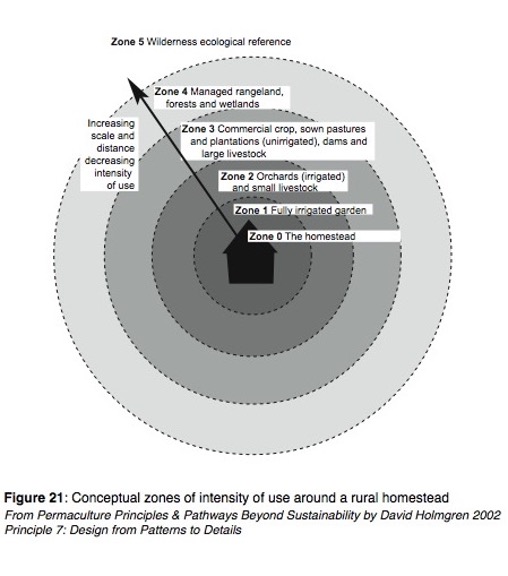 Permaculture Land Use Zones
By way of contrast, today I see many children raised according to theories and practices that avoid even the most basic domestic socialisation of behaviour in early and even later childhood. Those minimally socialised feral behaviours then spill out into the public and natural spaces. But almost everywhere, parents, carers, teachers and technology hover to monitor, protect and where necessary constrain children from the consequences of their own actions, including the negative feedback from peers, adults and nature. I see this widely observed and commented upon situation as stunting children’s freedom and ability to Observe and interact, the first permaculture principle. Further, it is a direct contradiction of the fourth permaculture principle: Apply self regulation and accept feedback. These prevailing patterns are now strongly reinforced by media and institutional norms such that only a few brave parents dare to ignore them, even though many recognise them as bad for children, stressful for parents and dysfunctional for community and society as a whole.
So does this application of permaculture design principles and tools to the raising of children, let alone the thorny issues of governance and regulation in society at large, reflect more general insights from the working relationship with nature that is the essence of permaculture?
Working with Nature
Going back to its origins, it’s clear that permaculture specifically, and environmentalism more generally, can be understood as a reaction to the excess power of economics and technology over nature, which are bad for both nature and humanity, at least in the long run. Mollison and I identified agriculture as the heart of the problem, which was then being supercharged by fossil fuelled technology and chemicals. This excess power to regulate, control and, if necessary, disable and disarm nature, was seen as a major factor contributing to the decline and collapse of past civilisations where urbanisation and loss of intimate working relationships with nature led to hubris about the benefits of the control and suppression of wild nature.
In more practical terms, we saw that the overproduction of a handful of highly bred (regulated) annual grains and pulses, grown with soil cultivation and water harvest methods that sought ever greater control of nature’s “difficult” species (weeds and pests) was counterproductive in the long run. Beyond minimising harm, and not putting all our eggs in just a few genetic baskets, permaculture design was focussed on facilitating and freeing the regenerative potential of nature to restore soil, water, biomass and biodiversity in ways that still provided for human food, material and energetic needs, if not wants and addictions.
In this sense permaculture, organics and other regenerative agricultural practices can be understood as restoring a balance between the regulation of nature to serve human needs on the one hand, and the need to free nature for both ethical and pragmatic reasons.
The pragmatic reasons include the recognition that, after the pulse of power from fossil fuels has faded, humanity will likely lose much of its ability to control and regulate the reality to which it has become addicted. Like the narcotics addict experiencing cold turkey, humanity could go through a forced accommodation of nature’s less regulated powers.
While the signs that “nature bats last” are growing stronger and more diverse, the hope and hubris about ever greater control over humanity’s place on this planet and beyond continues to grow, promising a world of ever greater regulation and control over circumstances.

Garden farming styles
In the grounded practise of garden farming, I characterise different approaches to organics and permaculture on a spectrum between Biointensive and Natural methods. When discussing this in RetroSuburbia, I acknowledged that personal preference and situation will make more (or less) control over nature, at least in the backyard, appropriate or not.
We combine this tension between regulation and freedom for nature in the garden with the zoning idea of control over what is close at hand and most immediately important, and being grateful for episodic abundance, delight and inspiration we gain from further afield.
Permaculture practice encourages us to accept we have no choice but to “let nature take its course” especially as we age: personally, and as an aging global civilisation with severe if not terminal health issues.
I’m wondering if all this clarifies where I sit on the spectrum from being an advocate of freedom of thinking and behaviour to regulation and control in society at large? I’m also curious about how a particular position on that spectrum helps in any strategies to either reform or avoid the pitfall of regulatory dysfunction in the wider society?


Comments